Saturday, May 15, 2021

Coquetterie


Donne-moi

L'espace que tu gardes

Pour ceux qui te passent

Et qui restent en toi

Pour ne pas se perdre


Parle tout doucement

Et dis les mots que j’aime

Comme une gamine sans face

Qui court dans les champs

Pieds nus et cœur battant


Laisse-moi être

Pour le court moment

Qui est notre carrefour

Le troubadour d'antan

Qui en t’attendant

A perdu son lyre


Et pour la première fois

Oublie les larmes du Fado

De Lisbonne ou d’Oporto

Que “partir é morrer oum pouco"

Et cours dans mes secrets champs

De coquelicots et tendres chants


Car demain

Un autre troubadour

Chantera ton nom

Du haut des toits

Où il restera, seul

Dans la douceur de l’espace

Que tu lui donneras

Comme revanche


Mai 15, 2021

© Vahé A. Kazandjian, 2021

Monday, April 19, 2021

Artemisia Was Absent


When I burned bitter dreams

Held by a flat silver spoon upon a cup where

Pain was washed down with cold water

As if dead carp in the river

Next to the catacombs of a city that has forgotten

How evil turns to anger


Artemisia was absent but I still called her name 


Artemisia was now just a name

Which

I once wrote on the sand

Of a city burning

Without a silver spoon

And without knowing why

I wrote on the sand

Of its beaches washed

By the times

By the tides

By unmoon nights

As I left the land that became

Someone else's land

Next to the bluest sea


Where Artemis lost her arrow


And her chastity

Under the half moon


And turned green

Like a fairy who lost her way

In the catacombs of a city

Next to a dark river

Where the beach was of concrete

And the name I had written

Was washed


In cold water

Over a flat silver spoon

Into a simple cup

That was now bitter


Because Artemisia was absent


April 19, 2021

© Vahé A. Kazandjian, 2021


About this poem: Artemisia absinthium is the common wormwood historically used to make absinthe. I was inspired by a visit to the catacombs of Prague where absinthe, made with wormwood, is available for experimenting. 

As such, this is not a poem about the 17th century Italian painter Artemisia Gentileschi....

Sunday, March 28, 2021

Vita Interruptus


Pull back

We had a swell

Time

Touched by a promise

We believed

In

Yet fell

Upon our backs

And waited


Push back

The low hanging

Fruit

Was picked last night

And the morning blue sky

Is now gray and dark

Peeping

Through the

Hanging

Old

Curtains


Hold still

Till the coffee percolates

And drips

With caprice

And with desire

In the unwashed cup

Left on the bed stand

Standing

Alone


And then

Recall a name

A place

A time

When face covering

Was a fantasy

To unveil

Yet another

Promise

To believe

In


March 28, 2021

© Vahé A. Kazandjian, 2021


Friday, March 26, 2021

From “My Land is Your Land (W. Guthrie) to “Ó Gente da Minha Terra” (Mariza) to “My Land and My People” ( Dalai Lama)


I enjoy listening to songs or classical music while driving more than I do in a house room or at the concert hall. So many variables interact at the same time when I insert a CD into the dashboard – the scenery keeps changing, the wind whistles differently depending on how much I crack the windows open, the sound of the road constantly changes under the tires, and I suddenly sound like a perfect tenor when I join the song!

So, I keep a multi-lingual selection of CDs in my car. I have Italian opera, French troubadour songs, Portuguese Fado, Arabic folkloric songs, Armenian popular songs, and Spanish classic guitar plays. Recently I added the CD of Silk Road music by Yo-Yo Ma.

When I have a few hours of drive (even an hour), I decide on the CD according to my mood at the moment.

A couple of weeks ago, when I had a drive to the upper country of Arizona (meaning in the mountains of an altitude of about 7,000 feet) I decided to fill the thinning air with the vibrations of Fado.

Fado is a typically Portuguese genre of “blues” that has its origins in port districts like Mouraria and Bairro Alto. Lisbon is where it blossomed in the 19th century and today the best Fado moments are still to be found in the “semi-dark ” bars in Bairro Alto where I had my introduction to the often soul wrenching songs and the 12 steel  strings guitarra.  I can still recall Tasca Do Chico and Café Luso.  I have written about my early experience here https://www.blogger.com/blog/post/edit/4995164429340748464/5769353108438927210 with B&W photos of a fadista.

So, the CD I have is called FADO: um tesouro português. I immediately chose Gaivota by Amália Rodrigues and Ó Gente da Minha Terra by Mariza. La grande dame of Fado is incomparable to any other fadista and she remains the ambassador of my memories of Portugal. But Mariza, for whom the above song was composed by T. Machado based on a text by A. Rodrigues, takes me beyond Portugal, to all the countries where people remember their land and ancestors or celebrate them if they are lucky to still live in these ancestral places.

Here are a few lines:

Oh people of my land

Now I understand

This sadness which I carry on

Was from you that I received

… I was now driving in the high mountains still their tops covered in snow. Suddenly the desert was transformed into Nordic scenery. It is a beautiful land. I felt humbled and lucky to live my days in this context.

And without warning, I started whistling the notes of the most popular American folksong by Woody Guthrie “This Land is Your Land”. While celebrating the grandeur of this land, this song has raised historical, cultural and social issues in a country that is three centuries old. This land has seen different cultures call it their own over this time period. And yet, it remains a land with much space for all.

Here are a few lines:

I roamed and rambled and I've followed my footsteps
to the sparkling sands of her diamond deserts
All around me a voice was sounding
this land was made for you and me

 Every country has a poem, a song and especially an anthem celebrating its motherland. Or is it fatherland? Or yet homeland? And these expressions of love and belonging are often precipitated when the land is in danger, through physical or cultural invasion.

Fatherland seems to be the oldest term used in English language to describe one’s country. It may be derived from the Latin patria, meaning fatherland.

Motherland may have its origins in the French language as terre mère. Although now the French use “la mère patrie” somehow mixing between motherland and fatherland.

Homeland does not refer to the land of my mothers or fathers, but rather the land where I belong. It is perhaps a reflection of the global movement of people and the globe being truly globalized. … As I was thinking about Russia being Motherland yet surrounded at its south by Nordic countries where their land is called Fatherland, I remembered the lines by a famous Armenian poet Silva Kabudikyan. In a poem to her son, she says:

And son, no matter where you go

Or under the moon wherever you stay

Even if you forget your mother

Never forget your mother tongue

(the translation is mine)

 Could it be that she was also addressing the movement during 1920 to the 1940s of Armenians leaving the “Motherland”? Indeed, today’s Diaspora of 5 million Armenians took shape during those years. If so, did she recognize that identity can survive through the preservation of language and culture even if one is not on his motherland or fatherland?

Perhaps the one who has given much thought to all this is the four-year-old son of a humble farmer sat on a huge, gilded throne in the Himalayan city of Lhasa. Then, in exile as a young man, he is declared the reincarnated leader of Tibet. Now the most recognized monk in world history, the Dalai Lama tells his story and the story of Central Tibet in his book “My Land and My People” while China classifies Tibet as part of the Motherland.


… I drove to the upper country of Arizona a few weeks ago. I did not write any of these thoughts on paper (or on the screen) as I did not further explore the ways in which our understanding of “my land” has a long history in national identity. 

But a few days ago, when I was walking with my dog (not “walking my dog” as he is truly an independent soul!) we came across a spot in the rocky hills where someone had camped not long ago. And in the fire pit, I saw the partly burned tree trunk that had a pristine bird nest on it! The sun being still in the East, the shadows drew a perfectly sad face at one end of the trunk. And leaves near the bird nest seemed like fingers protecting the nest.

I could not resist thinking about Gandhi, the Dalai Lama and FADO songs! So, I looked for the definition of a nation used during the debates between the British and Gandhi’s India:

“a nation is a body of people, associated with a particular territory, which is sufficiently conscious of its unity to seek or to possess a government peculiarly of its own.”

So, now I could write these lines.


PS/ here is the photo original size


here is a close up of the nest:


And the face with so much sorrow:


March 22, 2021

©Vahé A. Kazandjian, 2021

Tuesday, March 16, 2021

Saint-Exupery, Shakespeare and an Armenian Artist on a Snowy Day in the Desert

Sometimes, reading poetry on a frigid and snowy day does not make me remember or project. On days like this, a comedy movie or a book of fiction feel like Glühwein and Vanillekipferl I more than once had next to the Stefan Dom in Vienna in Christmases past. The warm vapors of the mulled wine and the cinnamon aroma have stayed with me over many decades and have taken a surreal character!

Just like Shakespeare’s “A Midsummer Night’s Dream” which I picked up and leafed through.

I have to admit that I have yet to read the entire book. It sits in my art studio among books of many languages, and when I feel like taking a break from a project, I pick up a book and leaf through it.

This time, I stopped at lines I had previously annotated. These are famous lines from Helena who remains my favorite character. She said:

“Love looks not with the eyes, but with the mind;

And therefore is winged Cupid painted blind.”

So, how does one avoid being distracted by abstract structural beauty and find the way to look inside another person?

This time, it was another classic book, also in the pile at the end of my workbench that I picked up. It is “Le Petit Prince” by Antoine de Saint-Exupery that has become a cult book for understanding relationships. It is said that he “saw” the young prince and the fox when in a daze from dehydration in the Algerian desert after his plane made an emergency landing. So, it may not be a “Night’s Dream” but it sure was a dream with some hallucination.

When the Petit Prince feels comfortable with the fox, he asks about his life and what is exciting.

Ma vie est monotone. Je chasse les poules, les hommes me chassent. Toutes les poules se ressemblent, et tous les hommes se ressemblent. Je m'ennuie donc un peu. Mais, si tu m'apprivoises, ma vie sera comme ensoleillée. Je connaîtrai un bruit de pas qui sera différent de tous les autres. Les autres pas me font rentrer sous terre. Le tien m'appellera hors du terrier, comme une musique.

(My life is monotonous. I hunt chickens, men hunt me. All hens are alike, and all men are alike. So I'm a little bored. But, if you tame me, my life will become bright. I will know a sound of footsteps that will be different from all the others. The other steps make me go underground. Yours will call me out of the burrow, like music.)

And then came the most recognized, powerful and deeply human passage:

Le renard se tut et regarda longtemps le petit prince:

- S'il te plaît... apprivoise-moi ! dit-il.

(- Please ... tame me! he said.)

Years ago, I took a photo of my son and my dog. It was a cold day, the river was frozen, and when I looked at the negative under the loupe, I saw Le Petit Prince and the renard! The “prince” and the renard have that exact posture of dialogue and request for one to tame the other.


And now regarding eyes.

So, Helena still hopes that Theseus would see her inner beauty and not desire the “outside” beauty of Hyppolita. But what kind of looks can penetrate so deep? How can we trust eyes to find the beauty in us, in others?

As a photographer and a painter I have a special attraction to eyes. And when eyes look candidly into another being, I think it makes for the best photo, the best painting and tells a universal story of love and trust.

For example, while my last dog looked like the fox in the previous photo, here a few years later he learned to look into a person’s soul! I blurred the young lady’s facial feature for privacy, but the tender moment between my dog’s “tamed” self and her remains.


As for the eyes I explore in my paintings, here are a couple of examples:


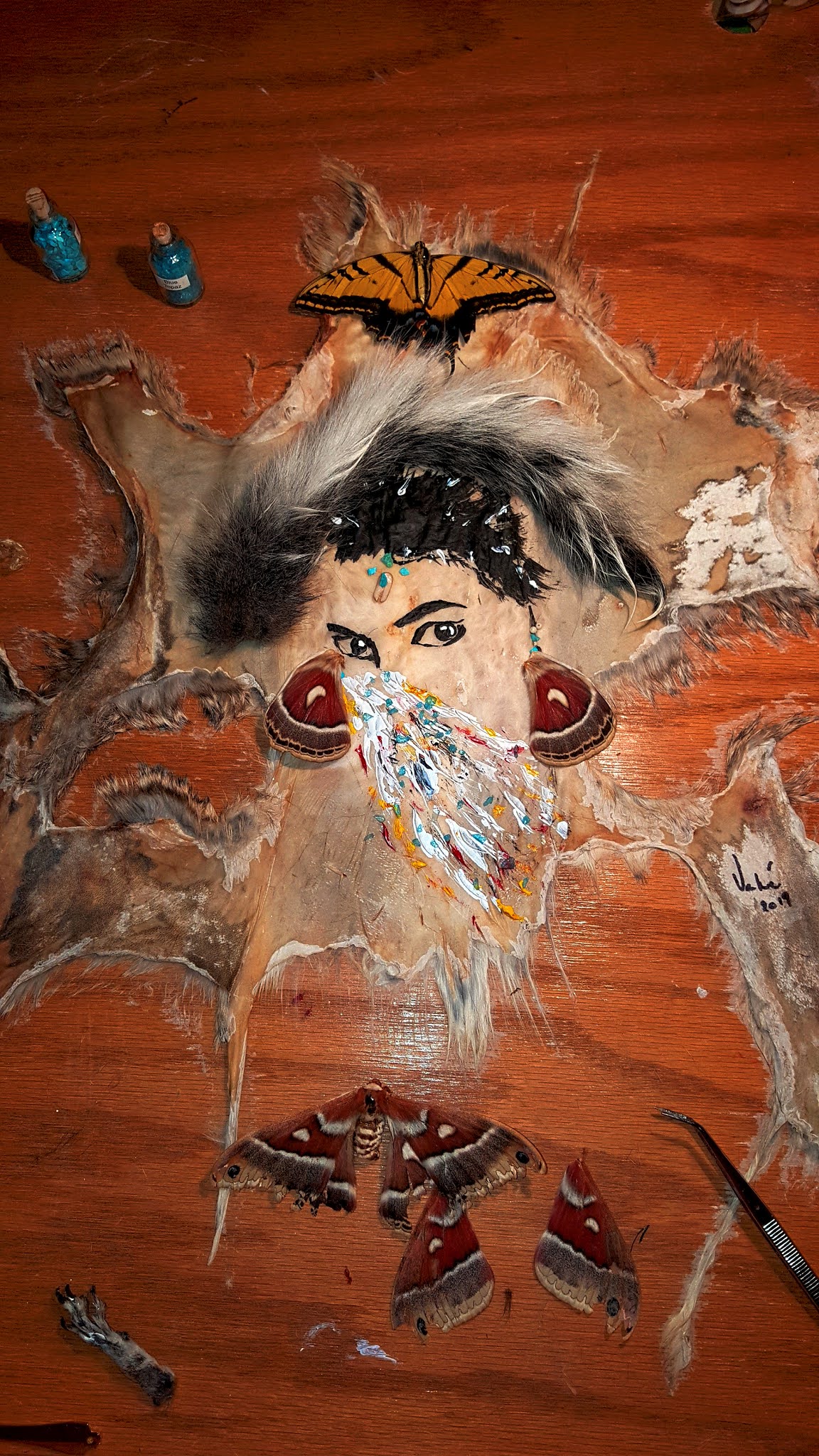
In this case, I was working on the concept of metamorphosis by using moth wings as her earrings and a butterfly atop the frame. In that transformation (from seeing external beauty to seeking the internal one) the looks I gave her are foxy, teasing but also confident. These are eyes that know where and how to search!

 In another painting, also inspired by the omnipresent mask of our new days, I felt at ease with softer, perhaps more passive looks. In both instance, the eyes are inquisitive – perhaps the second painting showing a woman who discovers who you are without you knowing that she was searching!


And finally, a photo I took in South Africa of a look that reminded me of looks I have seen around the Mediterranean where I grew in age and expectations. That is a look that gives you no choice for retreat. That is a look that even a blinded Cupid will see and tremble while holding his arrow!


… The snowflakes are still dancing a funny farandole outside my window. My dog, the one who succeeded Petit Prince’s renard, is sleeping on an old cheep skin rug outside my door.

And I am wondering what Helena will say next time I open the book….


March 16, 2021

© Vahé A. Kazandjian, 2021


Saturday, February 20, 2021

Would a Street Photographer Go to Chernobyl ?


On Valentine’s Day, I received feedback about my last posting on January 25th where I was using a rocking chair covered in snow on our balcony to discuss some of the comforts even harsh times can bring to us (https://vahezen.blogspot.com/2021/01/show-some-mercy-to-this-chair-which-has.html).

The feedback started with “hm, street photographer is flirting with rocking chair with veil of snow…”

The point is very well taken and it reflects the reality we all face around the globe, namely that people are not in the streets as much, and surely there are no mass events which provide a street photographer with the opportunity to observe and capture human behavior.

Yes, I do miss carrying a couple of old mechanical cameras with me and going out looking for a human story. I have done that around the world for half a century but in the past year I rarely take any camera with me since I know the streets will be empty.

While it chagrins me as a photographer, the past year has be delightful for my dog as he comes with me at every outing and has a great time meeting dogs who, just like mine, seem to be dragging their human counterparts behind them, on a leash!

But when I am driving I have my 1960s leather camera carry bag with me where a 1972 Soviet Salyut-S medium format camera and a 1953 Canon L3 35mm rangefinder camera are at the ready in case the stars come together for a frame or two.

So, after reading the comment on February 14th, I pulled out a few photos that are taken in the streets but not always of people. Indeed, they are photojournalistic and represent the past year. Specifically they demonstrate that when people vacate the city streets, wild animals come down and roam these streets day and night. Here are examples:

Peccaries at sunset: Around here they are called “wild pigs” but they are not boar. Originally from Latin Americas, peccaries indeed look and get as large as wild pigs. Most importantly they travel in groups and families, and the males can be very aggressive in protecting the group. They have long, spear like canine teeth hence are called javelin/javelina in Latin Americas.

The photo on the top of this page is of javelina crossing our neighborhood street after sunset.


Bobcat kittens next to our house: Native of North America, the bobcat (Lynx rufus) is a medium size predator that lives in warmer climates. It is not dangerous to humans but to all other animals of its size or smaller. It is also a very reserved, solitary and nocturnal hunter, but in the past year we have seen a number of predator mammals roam our empty streets. Here are bobcat kittens, delightful as any cat can be. But in a few months they will be looking for small dogs for dinner!


 Mountain lion (Cougar): Now we are talking about big cats! Indeed, an adult cougar can weigh more than 100 kg and attack humans and large animals like deer and elk.  We rarely see or hear about their nocturnal passages from our neighborhoods, but a couple of weeks ago the ground snow left the carte de visite behind our house…  The paw tracks are as large as my hands.


In the SouthWest  and NorthWest U.S, mountain lions pose a real danger to hikers and mountain bikers. Here is a sign from Arizona making that point:


Coyote: Of course these are the representatives of the SouthWest desert fauna. They are tricksters, smart, survive practically any environmental change and are accustomed to humans. But they are also very destructive to agricultural stock, dogs and cats, but rarely to humans. One can see coyotes everyday in cities and open desert spaces, but in the past year they grew totally unafraid of humans.

On Christmas day 2020, this one came to take a nap next to our car in the driveway….


 So, what is a street photographer to do when there are no humans in the streets? Of course I am optimistic that there will be open air concerts soon; that folks will ride their bike to shop at open stores; and, that the only four legged mammals we will see in the streets after sunset will be a dog we know or a cat we have seen before.

But till then, here is a perfect image of how few are benefiting from empty streets early in the morning!


And the cropped section shows the delightful resemblance between her body posture and that of the "pedestrian crossing" sign -- during a pandemic pedestrians can cross all streets, at any time!


February 20, 2021

© Vahé A. Kazandjian, 2021

Monday, January 25, 2021

Show Some Mercy to this Chair Which Has Stretched Out its Arms to You for So Long; Please Satisfy its Desire to Embrace You! (Molière)


It has been a massive storm now covering Northern Arizona’s high country where mountain ranges of the high desert go from 5,000 feet altitude to close to 7,000 feet. Almost 3 feet of snow fell in the past 24 hours transforming the desert topography to Nordic scenery.

I was not sure what to expect so in optimism and anticipation, I loaded my 1970s Soviet Salyut medium format camera with B&W film. Unfortunately the sun has been covered for two days now and, if I carry the 4 pound monster camera outside, the 25 mile/hour winds would fill my old “light box” with snow in a minute!

So, I was watching the storm from a window overlooking the balcony. One of the rocking chairs started to be filled with snow and stopped rocking alone at the wind.

My immediate reaction was that it was a sad chair. Lonesome and cold.

And that, somehow, reminded me of a poem by Jane Hirshfield titled “Chair in Snow” I had read many years ago online. Then, I had thought it was a tangible metaphor most people would identify with except perhaps the Bushmen of the Kalahari Desert!

So, I found that poem online(1) and read it again.


…“and yet a chair in snow is always sad


more than a bed

more than a hat or house

a chair is shaped for just one thing”


I stopped for a minute. What was that “one thing” for me?

Clearly a chair is for humans, although cats and dogs often make a chair their own. A chair is shaped in many ways, some inviting like a dulcet bed, others requiring uncomfortable acrobatics to use. But the purpose is often the same – to settle for a moment.

However, not everyone can settle down or in. My favorite summary of this character trait is by André Gide, Nobel Prize 1947:

Never have I been able to settle in life. Always seated askew, as if on the arm of a chair; ready to get up, to leave.

And leave he did. He left norms and some literary traditions behind to become the most famous French writer in the 1930s and 40s. In his words:

"Man cannot discover new oceans unless he has the courage to lose sight of the shore.".

So, a chair has to be matched to a person's character. A true character I recall from the sports world, cricket more specifically, was the New Zealander Glenn Turner. He put it simply:

"Worrying is like a rocking chair, it gives you something to do but it gets you nowhere”

Of course, all Turner thought about while playing cricket was to hit the ball and run between the wickets to make it to the other end without a fielder hitting the wickets with that ball. He did not seem to have been the type to worry too much – just run.

…I looked at the chair again. The storm had dumped (or the wind had moved around) much more snow leaving only half of the rocking chair visible. At this point it seemed that snow was sitting in the chair with a "snow arm" on the left arm of the chair.  It was a strange sight and I took a couple of photos with the Salyut.


Why?

Why would one take a photo of a chair “filled” with snow?

Perhaps because of what Andy Warhol once typically said:

“You would not believe how many people will hang up a picture of an electric chair, especially if it matches the colour of their curtains”

Ha!

So, after my own musing about Hirshfield’s idea as to that one thing a chair is shaped for, I continued reading her poem:


… “to hold

a soul its quick and few bendable

hours


perhaps a king


not to hold snow

not to hold flowers”


… My chair was now holding snow, and letting the wind blow parts of it away. The snow made my chair happy; its sadness seemed to fly away with the cold wind.


I thought it was a good thing to happen to a lonesome rocking chair. And it made me smile on this gloomy day. Maybe even made me happy like Albert Einstein suggested:


“A table, a chair, a bowl of fruit and a violin; what else does a man need to be happy?”

Nothing really. Or perhaps a warm blanket for a good night's rest in that chair.


January 25, 2021

© Vahé A. Kazandjian, 2021


(1)https://silverbirchpress.wordpress.com/2014/02/26/a-chair-in-snow-poem-by-jane-hirshfield/